
Due to the recent Atul Subhash case the internet is talking about how women misuse the laws given to protect them. One such discussion is about the rape laws and the false narrative that most women misuse rape law accusing men for a crime they never commit. I saw an Instagram reel that claims about 74 percentage of rape cases in India are reported as false as per NCRB. These figures are then used to argue that rape laws that favor women must not exist. I immediately search in the Internet to find whether this claim is true. I also saw a 2022 tweet on this.
Now the tfipost is a Right wing media in India and we need to look it from a skeptical lens. They said the data is from NCRB, but no citation were given. The only link they given to support their claim is another 2019 article from Times of India.
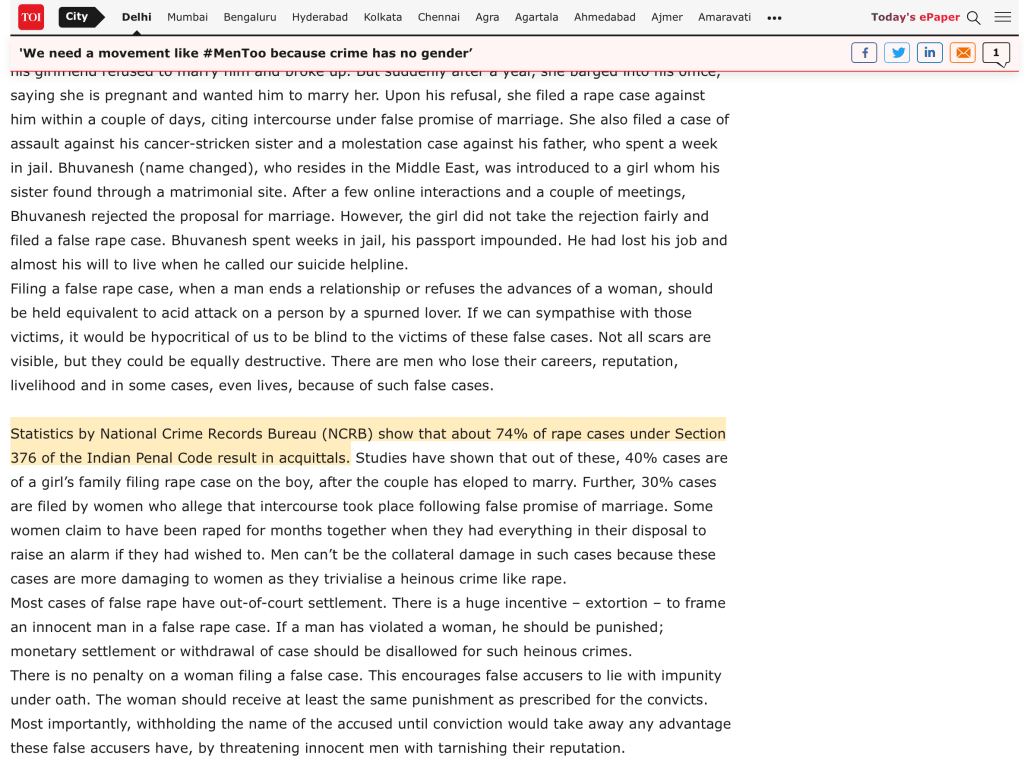
Again no citations were given. So I need to check directly from NCRB to find where people are getting this 74% figure.
The National Crime Records Bureau (NCRB) in India is a government agency responsible for collecting and analyzing crime data, including cases of rape and false accusations under IPC Section 376. It provides detailed statistics on reported crimes annually in its publication Crime in India. Unlike the above two articles NCRB must be treated as a reliable source even though this data is not the real reflection of the crimes happening in India.
What NCRB data is missing
The National Crime Records Bureau (NCRB) report is missing data for several reasons, including
- Under-reporting by victims
- Marital Rape is not considered as rape in India
- The methodology used by NCRB to classify and report crimes
- Lack of detailed information recorded in First Information Reports (FIRs).
Under-reporting of Sexual Violence: The NCRB data rely on First Information Reports (FIRs) filed with the police. It is estimated that only 1% of victims report sexual violence to authorities in India due to various reasons, including stigma, fear of ostracisation, and a lack of faith in the legal system. Many cases of sexual violence go unreported, leading to a significant underrepresentation of these crimes in the NCRB data.
Marital Rape is not considered as rape in India: The under-reporting is further compounded by the fact that marital rape is not considered a crime in India, meaning that instances of sexual violence within marriage are unlikely to be reported to the police. The National Family Health Survey (NFHS-5) indicates that approximately 29.3% of married women in India have experienced spousal violence. However, due to the marital rape exemption, these women lack legal recourse to prosecute their husbands for rape.

The “Principle Offence Rule”: The NCRB utilises the “Principle Offence Rule” to classify each case. This means that only the most serious crime in a case is recorded, even if multiple offenses are registered in the FIR. This leads to the under-reporting of rape-related crimes in cases that also involve other serious offences like murder. For example, in cases involving abduction, rape and murder, the case will be categorised as a murder, as it warrants the maximum punishment. This methodology obscures the true number of rape-related crimes within the data. Even in the 2012 Delhi Gang Rape case (Nirbhaya case) is recorded as Murder.
Passive Surveillance and Data Quality Issues: The NCRB data relies on information recorded by the police in FIRs. The quality of this data varies widely, and there are significant concerns about the accuracy and completeness of the information provided. There are limitations in how age categories are documented, and there is an overlap in the crime categories used to register FIRs, making it difficult to draw meaningful conclusions from the data. This lack of consistent and detailed information limits the usefulness of the NCRB data for understanding the nature and extent of rape-related crimes.
While the NCRB report provides valuable insights into trends in reported crime, it is crucial to recognize that the data is not complete and is likely to significantly underestimate the true scale of sexual violence in India. The limitations mentioned above highlight the urgent need for improvements in data collection, reporting and recording practices to better understand and address the issue of sexual violence against women and girls. The World Health Organisation’s injury surveillance guidelines should be considered to improve data collection practices. The NCRB should make de-identified individual-level data available to allow for a more thorough analysis of potential risk factors, which would aid in developing more effective prevention strategies.
The Data from NCRB
The data is available to anyone in the NCRB site. You can filter by year to get previous data, the latest is 2022. It’s very likely that the articles that come up with 74% figure is analysis Court Disposal of Crime Against Women Cases (Crime Head-wise). Also they are looking at the Acquittal rate and interpreting it as false case. This is simply false and misleading.
The Acquittal vs Conviction (Court Cases Analysis)
This measures the outcome of court trials: the percentage of cases that result in acquittal.
A ~70% acquittal rate indicates that the accused were not found guilty “beyond reasonable doubt” in most cases.
Why This May Not Represent False Accusations:
- Acquittal ≠ False Allegation: Acquittal does not mean the case was false; it only means there was insufficient evidence to prove guilt. Legal trials require high standards of evidence.
- Reasons for acquittal include:
- Lack of evidence or poor investigation.
- Victims/Witnesses turning hostile and retracting statements due to societal pressure or intimidation.
- Delays and procedural issues affecting case outcomes.
High acquittal rates could reflect systemic failures (police inefficiency, witness tampering, societal stigma) rather than falsity of allegations.
What we instead be looking is at the Police Disposal of Crime Against Women Cases (Crime Head-wise) I’m not saying this analysis is accurate either. However this is closer to identifying intentionally fabricated complaints from NCRB data but it still can be influenced by investigative biases.
False Cases in Police Final Reports
- This analysis looks at the percentage of cases deemed false by police after investigation, which shows 8%-11% in this case.
- A “false” classification indicates cases where police conclude:
- The complaint was intentionally fabricated.
- There was no evidence to support the allegations after investigation.
Are women always to blame?
These article and figures are quoted in social media to paint a negative picture on women misusing the rape laws. The narration being most women are intentionally using these laws in their favor. However their are more nuances here. The NCRB data and associated statistics rarely capture the complex realities behind why cases are classified as false or why complainants withdraw or turn hostile during legal proceedings. Here’s a breakdown of these complexities and why they matter:
1. Withdrawal or Hostility Does Not Equal Falsehood
- Social Pressure:
- Survivors of sexual violence often face stigma, victim-blaming, or threats, compelling them to withdraw their complaints.
- Families or communities may pressure survivors to reconcile with the accused, especially in cases involving acquaintances or family members. (There is NRCB data showing in most of the accused is related to victim)
- For why people do victim-blaming watch this video presentation by Pratish
- Fear and Retaliation:
- Survivors may turn hostile out of fear of retaliation by the accused or their families.
- Economic Dependence:
- In some cases, survivors are economically dependent on the accused, leading to withdrawal or hostile testimony.
- Systemic Failures:
- Delays in investigation or trial proceedings can discourage survivors, causing them to abandon the case.
2. Parental Disapproval and Eloped Couples
In conservative or patriarchal communities, elopement is seen as dishonorable. Especially when it is inter-caste or inter-religious relations. Parents may file rape cases against a daughter’s consensual partner as to nullify the marriage and regain control over the daughter to appease societal expectations.
Courts often rule these as “false cases” if it is proven that the relationship was consensual and the survivor denies the allegations.
3. Settlements Outside System
Many cases are settled outside, especially if the accused offers financial compensation or marries the survivor under pressure.
Such settlements are more common in cases involving family members or acquaintances.
Implications: Settlements often prevent justice, as survivors are coerced into dropping charges rather than seeing the case through trial.
4. Misclassification of Case
False Case Classification: Cases dismissed as “false” by the police may include cases where:
- Police don’t find the victim convincing enough due to influence by rape myths
- It’s a High profile cases and the accused in a power position
However the social media is portraying all these to blame women of misusing the Rape Laws. This skewed perception of data is used to convey that rape laws should not favor women and men should get more leeway. This public perception also discourage more women from reporting incidents.
Conclusion
Majority of the rape cases in India are gone unreported. Any women you know might have gone through this but couldn’t report due to existing conditions. Still meninists want to make it more difficult for women to report rape cases. Demanding that the victims name should also be published along with the accused and the rape laws must not be this favourable to women. Rather than encouraging women to report genuine cases they are making it far difficult for women. This discussion of false cases is taking away the limited space that the law has to protect and provide justice for the women.
 Reductio
Leave a comment