“Reason shows me that if my happiness is desirable and good, the equal happiness of any other person must be equally desirable” – Henry Sidgwick
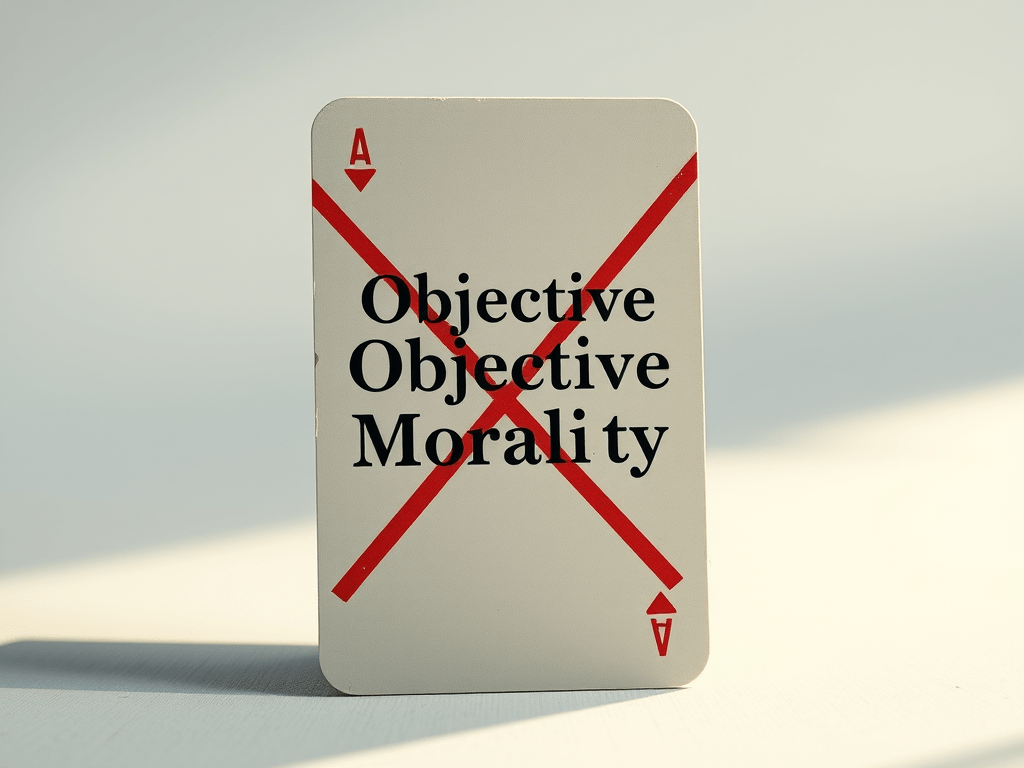
Objective morality has a different meaning in academic circles compared to ordinary understanding.
When a typical apologist claims that atheists can’t have objective morality, they usually mean something like this: there’s no universal agreement about morality, or morality has changed over time, and so on.
In philosophy, particularly in metaethics, the term has a more precise meaning. Philosophers argue that objective morality involves stance-independent facts—facts about what ought to be, independent of any individual’s beliefs, feelings, or perspectives.
Most laypeople are unaware of Hume’s Guillotine, a foundational concept in metaethics. The idea distinguishes between descriptive facts (what is) and prescriptive statements (what ought to be).
- Descriptive facts: Water is H₂O. Humans are usually selfish.
- Prescriptive statements: Water should be H₂O. Humans should be selfish.
The debate centers on whether prescriptive statements are just opinions or whether they hold some independent truth value.
If morality is objective, then a framework like utilitarianism provides true moral prescriptions, which we discover using our basic moral intuitions.
If morality is not objective, then utilitarianism still provides moral prescriptions, but these are inventions based on our basic moral intuitions.
In either case, our moral intuitions should be coherent structure. We use rationality to determine which principles align with these intuitions through thought experiments, real-world examples, and reflective coherence.
Would an immoral person suddenly behave morally upon realizing that stance-independent moral facts exist? I doubt it.
Personally, I don’t believe morality is objective, and frankly, I don’t care. Understanding the ontological status of morality has no practical implications.
It’s like a wager:
- If we act as if morality is objective, we lose nothing.
- If morality is subjective, we wouldn’t be doing wrong.
- If morality is objective, we would be doing the right thing.
It’s a win-win scenario.
 Reductio
Leave a comment