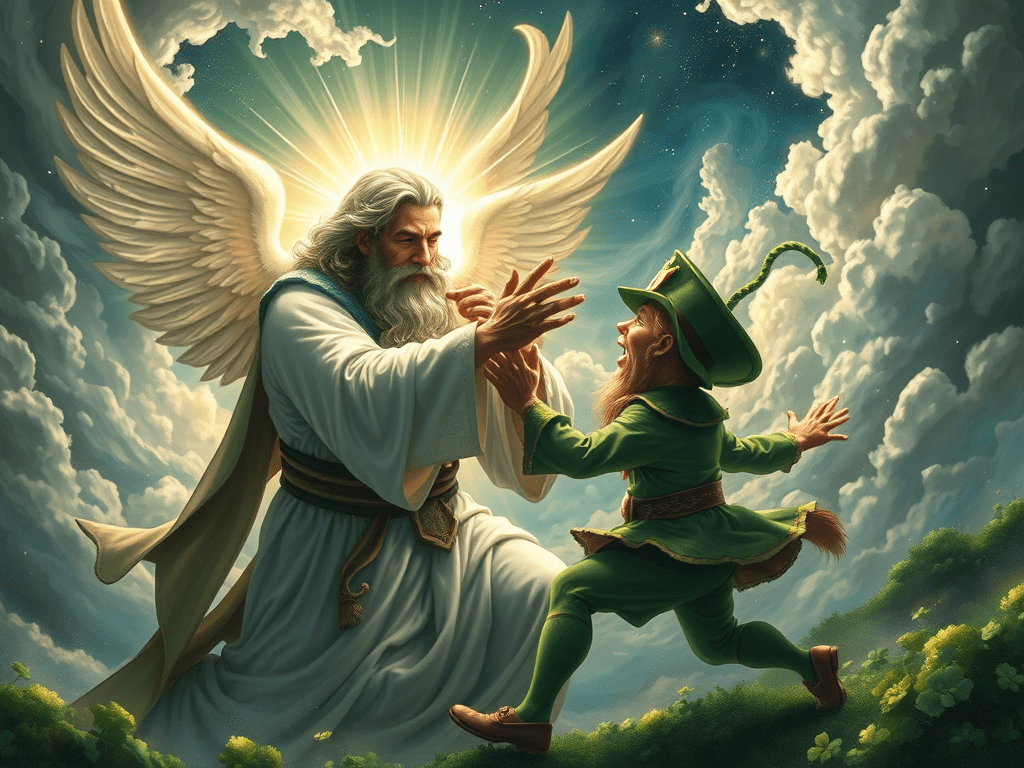
Why is God considered a serious hypothesis, while a leprechaun creating the universe is dismissed as unserious? After all, a leprechaun—just like a deity—could be imagined as accounting for all observable evidence. Yet, non-God creators are rarely entertained in philosophical or scientific discourse. The difference lies in prior probability.
Roughly speaking, the probability of a hypothesis given the evidence depends on two factors: how likely the evidence is if the hypothesis is true, and how likely the hypothesis was before considering the evidence. In this framework, theism is often treated as having a much higher prior probability than other supernatural alternatives. But why?
One of the most well-constructed answers comes from the Oxford philosopher Richard Swinburne. Swinburne argues that theism is a highly probable hypothesis because it is simple. God, in this account, is a single entity with no limits to her power and no limits to her rationality. A rational being with no limitations will, presumably, do what is morally best—thus giving theism great predictive power.
From this simple hypothesis, one can derive empirically relevant predictions: that God would create conscious agents, give them moral knowledge, and promote harmonious mental states. In this view, theism is not only metaphysically elegant but also empirically fertile.
But why believe that simpler theories are more probable in the first place?
Swinburne offers two main arguments: simplicity is intuitive—we naturally gravitate toward simpler explanations. And simplicity works in science—simpler theories have historically been more successful, so the same logic should apply in natural theology.
To illustrate, imagine two scientists offering competing theories about tomorrow’s sunrise. Isaac Newton says the sun will rise because gravity always functions reliably. Walter White says the sun will rise because gravity will function reliably for just one more month and then stop. Both theories predict tomorrow’s sunrise, yet science would never treat Walter White’s theory as seriously as Newton’s. Why? Because Newton’s is simpler. Swinburne uses this point to generalize: simplicity is what gives theories their initial credibility, even before evidence fully confirms them.
This preference for simplicity, Swinburne argues, should also apply when comparing worldviews like theism and naturalism. A single omnipotent, omniscient being is—on his account—simpler than an ensemble of finite supernatural beings or brute naturalistic facts.
But here’s the problem: all of Swinburne’s criteria for simplicity can be explained directly through induction. We have good inductive reason to believe that gravity will continue to work fine after one month, and therefore Walter’s theory is wrong. This brings us to a deeper issue: what justifies inductive reasoning in the first place?
This is the classic philosophical deadlock. One might try to justify induction by appealing to the simplicity of nature. But then we’re forced to ask: how do we know the universe is simple? If we answer that with induction, we are caught in a circular argument.
Thus, we are left with a few options: take simplicity as a fundamental assumption, take induction itself as fundamental and adopt something like John Norton’s Material Theory of Induction, which justifies induction in a local, case-by-case manner. According to Norton, inductive reasoning is valid only when supported by specific material facts. These background facts form a kind of coherentist network that grounds our reasoning.
However, taking simplicity as fundamental comes with some adverse consequences—it ignores modesty in hypothesis formation. For example, we know that the outcome “a coin lands heads 20 times in 20 tosses” is less likely than the outcome “at least one head and one tail.” The latter is a more modest claim and thus more plausible. But if we assume simplicity as fundamental, then, prima facie, the hypothesis that the coin always lands heads is simpler, and hence more probable.
According to simplicity theorists, the only reason we think coin tosses are 50/50 is that we’ve observed them behaving that way. But this retrospective justification is deeply unsatisfying.
In contrast, Norton’s material theory gives us a better account. If we lack background material to support any inference, we should default to a modest, symmetrical expectation—like assigning 50/50 probabilities. As we gain more background knowledge (about coin symmetry, dynamics, etc.), we can begin to justify more specific predictions.
The same logic applies to larger questions—like whether the sun will rise tomorrow. Without knowledge of the Earth’s rotation, gravity, and astronomical patterns, we would have no justification for assuming the sun will rise. But once we acquire that knowledge, our inductive inference becomes justified.
The point here is that induction can be used to explain why simplicity works, and if we take simplicity as fundamental, there will be counterintuitive results. We should prioritize inductive support as more fundamental. It is not necessary to adopt the material theory of induction; any reasonable theory would conclude that observing an entity has one power does not give you reason to think it has all powers.
Similarly, the only known fact is that the initial state of our reality—whether it be God or something else—had the power to create the secondary state. This alone does not provide a proper reason to believe that it had all powers. So while the induction done in science is justified due to proper background knowledge, the induction about God is unjustified. Therefore, the prior probability of God will be astronomically low because it’s not at all a modest hypothesis.
 Reductio
Leave a comment