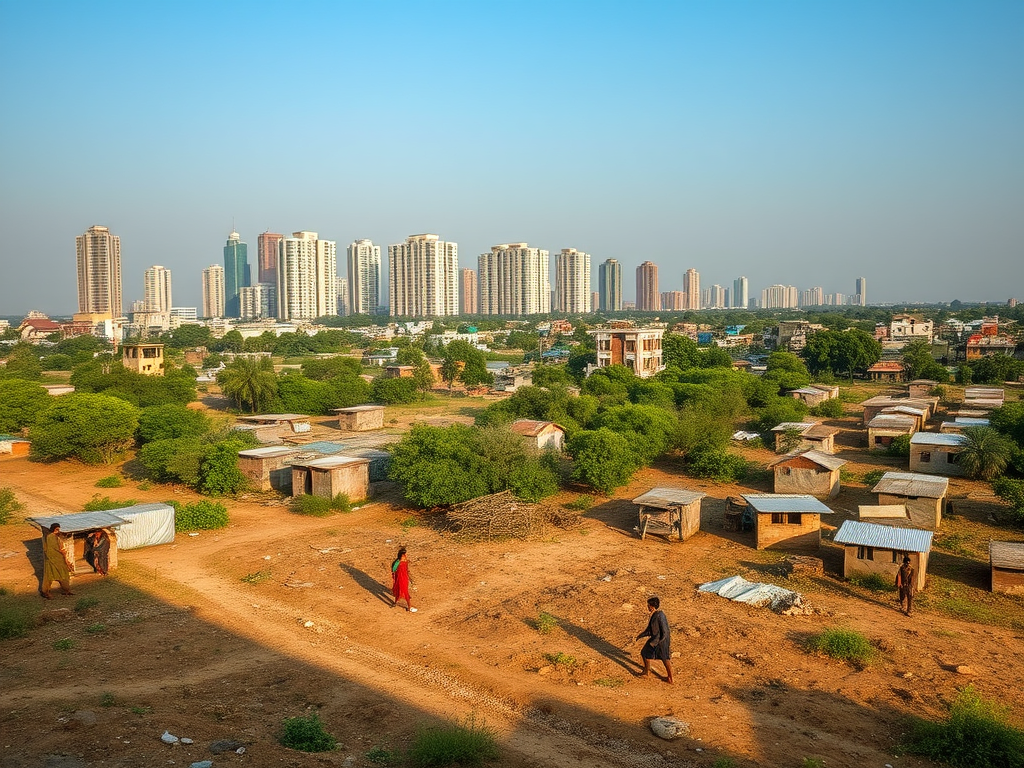
Last year, just two months before the Lok Sabha election, NITI Aayog Chief Executive Officer B. V. R. Subrahmanyam made a statement that poverty in India had reduced to 5%. This was groundbreaking because the last data we had was from the 2014 Rangarajan Committee report, which stated that poverty in India was at 29%. The BJP government began its first term in 2014, so you can guess the narrative.
However, this 5% figure faced heavy criticism. Even though GDP increased and poverty was expected to decline, there was no significant wage increase for the lower class. So, how did poverty reduce so drastically?
To understand what’s going on here, we need to have a basic understanding of how poverty is calculated in India. After independence, under the leadership of Jawaharlal Nehru, the Planning Commission was formed for centralized planning of India’s development. They recognized that data on poverty in India should be a significant focus.
The first attempts to determine a poverty line were based solely on the most primary criterion for poverty: food. Data for this was taken from the National Sample Survey (NSS). The first study was conducted by economists V. M. Dandekar and Nilkanth Rath, who estimated a minimum intake of 2,250 calories per person per day. They calculated this using 1960–61 data, and according to their report, you were above the poverty line if you earned more than ₹14.17 per month. They estimated that 42% of people in India were below this poverty line.
However, the first official poverty line was determined in 1979 by Y. K. Alagh.
The Alagh Commission slightly increased the calorie threshold, and as a result, poverty in 1972–73 was estimated to be 50%. The monthly income threshold was set at ₹49 for rural areas and ₹56 for urban areas. This became the first official poverty line and remained in place until 1993. During this period, the poverty line was adjusted only for inflation rather than being recalculated based on updated consumption patterns or needs.
This adjustment was done using the Consumer Price Index (CPI). But there were two main issues with this method. Firstly, a flat CPI inflation index was used to adjust the poverty line. This means that although inflation affects different items differently, the Planning Commission used the average CPI-AL and CPI-IW for rural and urban areas respectively. In a country like India, with significant income inequality, this method skews inflation measurements. For example, the price of a radio might not face as much inflation as essential food items consumed by the poor. CPI tracks the prices of things people commonly buy, but averaging across such a diverse population distorts the real impact of inflation on the poor.
A much more serious issue was the neglect of changing spending patterns. All inflation-adjusted calculations assumed that the poor maintained the same spending pattern as in the base year—in this case, 1973–74. But in a growing economy, spending patterns change significantly. The liberalization of the Indian economy, in particular, reshaped how people spent their money.
The Lakdawala Committee, chaired by Dr. D. T. Lakdawala, submitted its report in 1993. However, no significant updates were made to the consumption pattern used to define poverty. Instead, the committee focused on developing state-based poverty lines and adopted a more granular CPI-based approach, which helped solve the first issue of inflation measurement.
After the Lakdawala Commission published its report, a growing debate—later known as the Great Indian Poverty Debate—began to emerge among economists. According to the Lakdawala method, poverty had reduced to 26% in 1999–2000, which raised concerns. The Planning Commission realized that CPI-based adjustments alone couldn’t reflect the poverty line accurately. Additionally, the Lakdawala Committee had used a uniform recall period—meaning survey respondents were asked how much they spent on food in the last month and how much they spent on clothes in the last month. But the frequency of spending on clothes and food is not the same, leading to distortions.
The Tendulkar Committee, led by economist Suresh Tendulkar, submitted its report in 2009 and redefined poverty beyond just a lack of calories. They used a mixed recall period and arrived at a poverty line of ₹446 in rural areas and ₹578 in urban areas, which yielded a poverty estimate of 37.2%. This was significantly higher than the Lakdawala report, suggesting that inflation-based adjustment underestimates poverty if used over long durations.
Economists argued that even this was an underestimation—₹27 per day was not a realistic standard for a poverty line. This criticism led to the formation of the final commission, chaired by former RBI governor Dr. C. Rangarajan. Using the Tendulkar Committee method, the estimated poverty rate in 2011 was 21.9%, while the new adjustments made by the Rangarajan Committee raised it to 29.5%.
However, in 2014, just as the Rangarajan Committee submitted its report, the BJP government came into power and dissolved the Planning Commission.
The HCES survey was conducted in 2018, but the results were never published, making it impossible to calculate poverty in India during that period. However, in 2024, HCES released its latest survey data from the 2022–23 period, allowing for the calculation of consumption poverty in India once again. As mentioned at the beginning, NITI Aayog and others claimed a poverty rate of 5–10%, based on adjustments to the poverty line from the Tendulkar or Rangarajan Committees, using the Consumer Price Index (CPI) for inflation.
But we already have clear evidence that adjusting the poverty line in this way does not work over such a long period, due to significant changes in spending patterns. The most appropriate way to determine a new poverty line is by following the methodology recommended by the Rangarajan Committee. Using the HCES 2022–23, the Periodic Labour Force Survey 2022–23 (PLFS 2022–23), and nutrition intake norms prescribed by the Indian Council of Medical Research – National Institute of Nutrition in 2020 (ICMR – NIN 2020), we can construct a more accurate poverty line.
This was actually done by C. A. Sethu, L. T. Abhinav Surya, and C. A. Ruthu. Their calculation, based on the Rangarajan Committee method, shows a poverty rate of 26%—far higher than what the government claimed. It’s worth noting that India’s GDP doubled over this period. So if the condition of the poor didn’t improve, then who benefited?
The answer is fairly obvious. Ambani’s wealth increased nearly fivefold. Adani’s wealth increased over 25 times. Infosys employees are getting salary hikes. We don’t need to be super brilliant to recognize that these manipulated poverty figures are just gimmicks to win elections.
 Reductio
Leave a comment