Recently, there was a clubhouse room where the presenter produced some arguments against Abiogenesis from probability and mathematics
The link can be found here : https://www.clubhouse.com/room/MwYj0l6v?utm_medium=ch_room_xr&utm_campaign=yKGf-Bh0K8ywmvwCUXiCuQ-844394
Even though there is a lot to critique in the presentation, I would be focussing only on the points which I feel should be addressed.
Claim 1: “The first life is a cell as per Abiogenesis”
[Timestamp: 00:22:25-00:23:01]
It is wrong to assume that a simple cell would be the “first” life. There are many possible candidates for being the first possible life, I am mentioning just two here , and I am sure there must be more
- a self replicating molecule [1]
- groups of catalysts like RNA polymerase [2]
Claim 2: “Michael Denton is an atheist who wrote the book – Evolution: A Theory in Crisis”
[Timestamp: 00:23:50-00:24:40]
It is being claimed that Michael Denton is an atheist by the speaker, but it is hard to find any relevant references for the same. I tried searching online for the same , but didn’t find any sources other than claims made from apologist sites.
Some of the red flags that I noticed are
- His bio reveals that he is a senior fellow at the very infamous creationist institute – Discovery Institute’s Center for Science and Culture
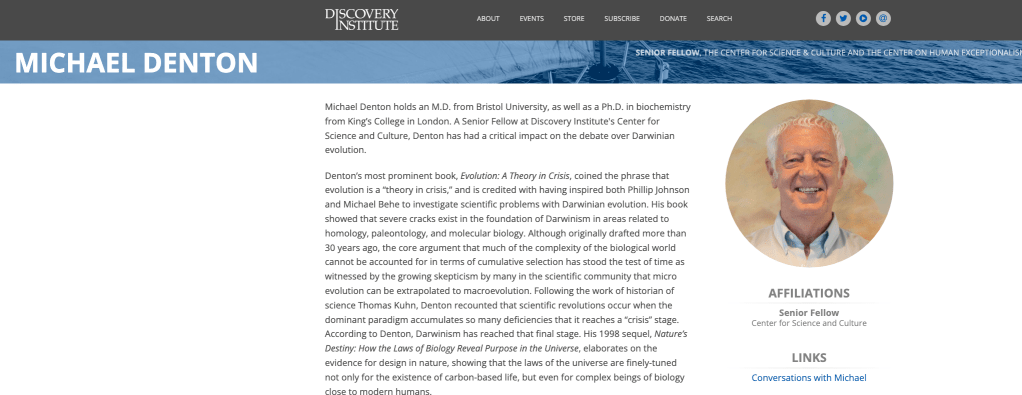
- He has written a book named – Nature’s Destiny: How the Laws of Biology Reveal Purpose in the Universe where he defends fine tuning argument.
- His work got very harsh criticism from the scientific community
“A book by an author who is obviously incompetent, dishonest, or both — and it may be very hard to decide which is the case — ordinarily is not worth the attention of a professional scholar. If, however, the deficiencies are not apt to be recognized by the audience to whom a work is addressed, warning potential readers might be a valuable service. And discussing some examples of fallacious and false premises can sometimes be a useful exercise.”
Michael T. Ghiselin [3]
“The book belongs to the “creation science” genre. Denton’s presentation differs from the usual creation science works in only one respect: he does not actively espouse the creation science claim for a scientific basis in Genesis. The book, therefore, has the appearance of being strictly a book on biology. Intelligent laypersons reading Denton’s book may think that they have encountered a scientific refutation of evolutionary biology. As a serious piece of biology, however, the book could not pass the most sympathetic peer review. In its approach, methods, and style it is straight out of the creation science mold. Abuses typical of creation science literature abound: evolutionary theory is misrepresented and distorted; spurious arguments are advanced as disproof of topics to which the arguments are, at best, tangentially relevant; evolutionary biologists are quoted out of context; large portions of relevant scientific literature are ignored; dubious or inaccurate statements appear as bald assertions accompanied, more often than not, with scorn..”
Philip T. Spieth [4]
So it is clear from his bio that he is certainly a proponent of intelligent design . So even if we agree that he is an atheist, his affiliations with such institutes that promote pseudosciences and the fact that academics has given harsh reviews to his book is good enough to doubt the validity of his arguments
Claim 3: “Wistar symposium”
[Timestamp: 00:41:12-00:42:43]
In Wistar symposium, there were 7 speakers out of which only 2 presented arguments questioning soundness of evolution.
The first challenge came from Murray Eden, then an engineer at the Massachusetts Institute of Technology in the United States. The other was from Marcel-Paul Schützenberger, a mathematician then at the University of Paris in France
The symposium was chaired by Nobel laureate Peter Medawar. Among the presenters were Ernst Mayr and Richard Lewontin, both among the first tier of biologists of their time, and mathematician Stanislaw Ulam, who had been part of the famed Manhattan Project
Eden’s claim: The truffle hog argument
Eden asked everyone to imagine a chain with 250 links. We find that there are 10^325. possibilities.
In contrast to this very large number, Eden put forth 1052 as the number of proteins that could ever have existed in any organism in all of natural history
Stanislaw Ulam made the following comment at the start of his own presentation:
“I believe that the comments of Professor Eden, in the first five minutes of his talk at least, refer to a random construction of such molecules and even those of us who are in the majority here, the non-mathematicians, realize that this is not the problem at all.
A mathematical treatment of evolution, if it is to be formulated at all, no matter how crudely, must include the mechanism of the advantages that single mutations bring about and the process of how these advantages, no matter how slight, serve to sieve out parts of the population, which then get additional advantages. It is this process of selection which might produce the more complicated organisms that exist today.”
Schützenberger’s claim : Genetics is like a computer program
Schützenberger’s intent was that we are thinking about a genotype as a sequence of letters, and that mutations can be thought of as changes to those letters. The second was that when random typographic changes were made in computer programs, the result was usually an entirely nonfunctional program
Lewontin said to Schützenberger:
I think the answer is that you have over-estimated the number of absolutely meaningless changes that occur when you change a single nucleotide. If we list all single nucleotide changes and the known translation vocabulary between nucleotide triples and insertion of amino acids, and then we list for a given protein all the results on that protein of changing amino acids all over the molecule, we will find, in fact, that a very large proportion of those do not render the molecule meaningless in an absolute context.
Claim 4: “Hoyles claim”
[Timestamp: 00:43:00 – 00:44:34]
Hoyle’s claim that the chance of obtaining 2000 enzymes in a random trial is one part in 1040,000 is famously called as Hoyle’s fallacy [5]
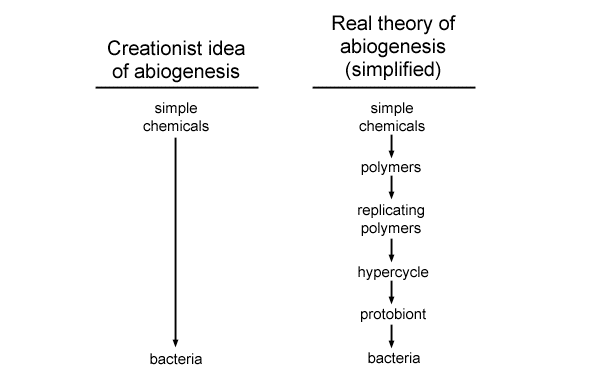
The problem with this type of argument made by Hoyle is that
- Hoyle used modern protein to calculate probability but abiogenesis is not concerned with modern proteins
- False assumption that there is a fixed number of proteins with fixed sequence required for life.
- Hoyle used the probability of sequential trials, rather than simultaneous trials.
Claim 5: “Events with very less probability are IMPOSSIBLE”
The speaker pinned a document which contained the following claim.

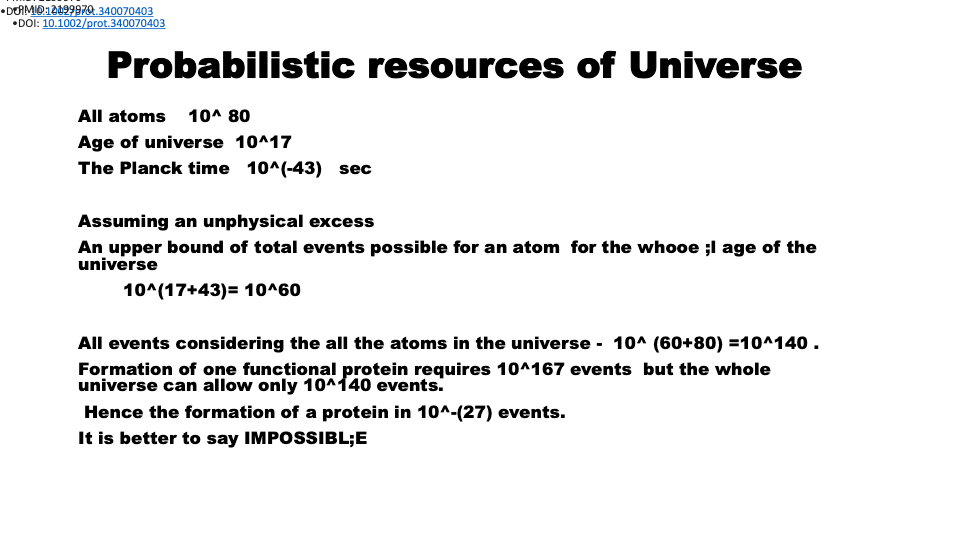
Structure of these kind of arguments
Regardless of the precise variation, the underlying logic of the argument is always the same:
- Identify a complex biological structure, such as a specific gene or protein.
- Model its evolution as a process of randomly selecting one item from a very large space of equiprobable possibilities.
- Use elementary combinatorics to determine the size of the space, which we shall call S.
- Conclude that the probability of the structure having evolved by chance is 1/S, and assert that this is too small for evolution to be plausible. [6]
Problem 1: Events with 10^167 probability do happen in universe
It will be clear from an example:
Imagine that you have a deck of 10 cards each numbered from 0-9. You ask 167 people to choose a number from the deck one at a time and replace the card back to the deck . Every time, a person chooses a number, you write down the selected number. At the end of the exercise, you have a 167 digit number written with you. Now what is the probability of this number being chosen ?
Cleary it is one in 10^167 . Does that mean that this event is impossible?
So what went wrong here? It is quick for us to fall into a common intuition that if something happening has a probability of 10^167, then for it to happen, atleast 10^167 events MUST happen.
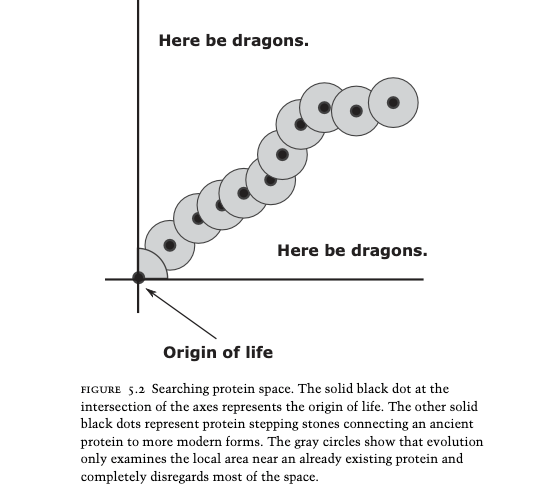
Problem 2: The vast probability space is useless for evolution
Problem 3 : The argument misses out the key function of natural selection
Problem 4: The probability is calculated using sequential trials rather than simultaneous trials
Problem 5 : The argument is invalid
Pr(O|H) is low
O is found to be true
Conclusion : O is an evidence against H
The above argument is invalid.
References
[1] Lee DH, Granja JR, Martinez JA, Severin K, Ghadiri MR. A self-replicating peptide. Nature. 1996 Aug 8;382(6591):525-8. doi: 10.1038/382525a0. PMID: 8700225.
[2] Ekland EH, Bartel DP. RNA-catalysed RNA polymerization using nucleoside triphosphates. Nature. 1996 Sep 12;383(6596):192. doi: 10.1038/383192a0. Erratum for: Nature. 1996 Jul 25;382(6589):373-6. PMID: 8774888.
[3] The Illogic of Creationism An Essay Review by Michael T. Ghiselin, based on “Evolution: A Theory In Crisis” by Michael Denton Adler & Adler, Bethesda, MD 1986
[4] Review: “Evolution — A Theory in Crisis” https://ncse.ngo/review-evolution-theory-crisis
[5] Hoyle’s fallacy
[6] The Failures of Mathematical Anti-Evolutionism, Jason Rosenhouse


Leave a Reply